Thinking Cultural Boycott Together.
Debates, Workshops, and Screenings
Marseille, July 8–11, 2026
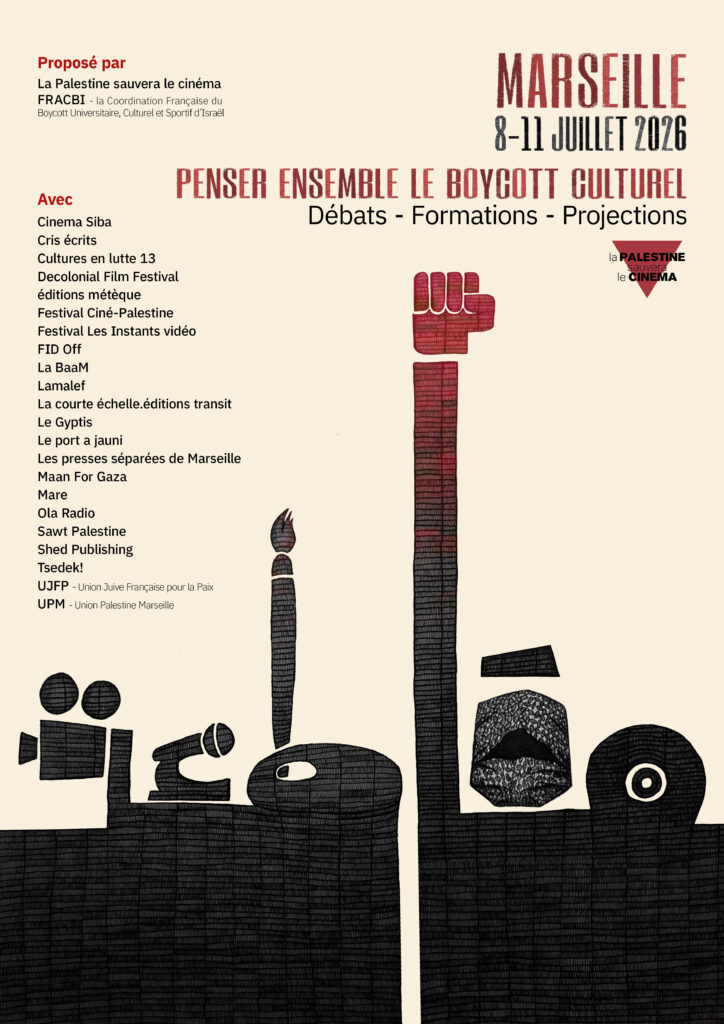
Organized by the collective Palestine La Palestine sauvera le cinéma and the French Coordination for the Academic, Cultural and Sports Boycott of Israel (FRACBI),
In collaboration with Cinema Siba, Cris écrits, Cultures en lutte 13, Decolonial Film Festival, éditions métèque, Festival Ciné-Palestine, Festival Les Instants vidéo, FID Off, La BaaM, La courte échelle.éditions transit, Lamalef, Le Gyptis, Le port a jauni, Les presses séparées de Marseille, Maan For Gaza, Mare, Ola Radio, Sawt Palestine, Shed Publishing, Tsedek!, Union Juive Française pour la Paix (UJFP), Union Palestine Marseille (UPM)
Free admission (donations welcome) No reservation required unless otherwise indicated. All discussions will be held in French.
PROGRAM
WEDNESDAY, JULY 8
Mona Benyamin draws on and subverts established codes, blending comedy and tragedy to tell stories of dispossession and the intergenerational transmission of memories and traumas tied to the Palestinian collective experience. Humour here is both an aesthetic and a political strategy “a hope that begins in the present and projects itself into the future.”
Curated by Line Ajan and Camille Ramanana Rahary.
Politics of Refusal and Spaces of Resistance
A conversation with filmmakers and cinema workers who signed the statement denouncing the FID Marseille—and, more broadly, film festivals—for their insistence on creating a false symmetry in their invitations and programmes between Palestinian (and Arab) productions and Israeli ones.“The priority is not to produce images of coexistence, but to act against a colonial and genocidal reality.”
For this political act of refusal, the signatories found themselves accused of essentialism and censorship within the film and cultural world, as well as in the French press. In short: they were not listened to. Why? What are the ideas and political positions driving this mobilisation?
With Fatma Cherif (programmer), Aude Fourel (director), Basyma Saad (director) and others. Video contributions from Ghassan Salhab, Monica Maurer, and more.
Moderated by Nadine Naous and Anna Roussillon, La Palestine sauvera le Cinéma collective.
Live on Ola Radio, a Marseille-based cultural web radio station.
“Palestinian narratives, archives of Arab struggles, and the memories of colonised peoples cannot be mobilised as mere tokens of openness that feed a clear conscience. Political courage is not measured by the number or the films programmed, but by the ability to acknowledge power relations.” (Oui le cinéma est politique) Film festivals and cinemas are also spaces of solidarity with the struggles of peoples and the oppressed—especially the Palestinian struggle for liberation against colonialism. How do we define a decolonial cinema? Can we programme political cinema without questioning our own structures and complicity? How can we assert ourselves (with our spaces, our terms, our fronts) in the face of the risk of capitalising on the aesthetics of struggle? How do we create spaces capable of rethinking the conditions in which our programming gestures take place? How can we shift power dynamics and move beyond moral posturing towards the political?
With Maya Boukella (Decolonial Film Festival), Sam Leter and Pauline Pénichout (Tsedek!), Anaïs Farine and Susanne Abu Ghaida (Festival Ciné-Palestine), Mathilde Rouxel (Association Jocelyne Saab),Meriem Rahbi and Charlie Andriol (Videodrome 2) (Videodrome 2), and Coline Costes (FID OFF).
Moderated by Samy Benammar, independent filmmaker and programmer.
Open discussion with the audience and other collectives and programmers present.
9pm Palestinian meal by Sawt Palestine (€10), in support of the association.
THURSDAY, JULY 9
A decade after the Oslo Accords, and in the face of the ongoing colonization, apartheid, and ethnic cleansing in Palestine, numerous Palestinian organizations called for the creation of an international solidarity movement capable of exerting effective pressure on Israel. This led to the launch of the Palestinian Campaign for the Academic and Cultural Boycott of Israel (PACBI) in 2004, followed by the broader Boycott, Divestment and Sanctions (BDS) campaign in 2005.
We must collectively organize to respond to PACBI’s call and compel Israel to respect the rights of Palestinians. This initiative is all the more necessary because culture has become one of the principal showcases through which Israel launders and normalizes its colonial policies, promoting an image of itself as democratic, liberal, and self-critical. Cultural boycott—which often raises questions and uncertainties—is a response to this strategy of normalization.
Open to filmmakers, artists, cultural workers, activists, and anyone interested, this workshop will introduce the principles of the cultural boycott, examine its political stakes, and discuss strategies for organizing effective campaigns. It will also provide practical guidance on applying the boycott within the film sector through a guided reading of the PACBI guidelines and an analysis of concrete case studies.
The training will be led by members of the French Coordination for the Academic, Cultural and Sports Boycott of Israel (FRACBI), established in 2026 by BDS activists, artists, academics, educators, and athletes to coordinate boycott actions across these sectors.
Further information to be announced.
FRIDAY, JULY 10
SATURDAY, JULY 11
Why are oppressed people expected to justify their use of boycott—their only peaceful means of making themselves heard? Why do European cultural institutions, and the French film world in particular, regard calls for refusal issued by Palestinian artists and their supporters as so problematic?
How can boycott be considered a legitimate instrument of state policy (for example against Russia, Iran, or South Africa), while at the same time being condemned as censorship and an attack on freedom of expression when it is used by Palestinians? Why does it not restrict artistic creation or circulation but instead constitute an essential political and ethical choice in a time of genocide and imperialist wars? How might it offer a method for turning culture into a space for collective organization and action against the ongoing rise of fascism?
Resisting a colonial reality, dismantling dominant ways of seeing and systems of power, and confronting structures of domination.
The event will open with a video message from Saleh Bakri, Palestinian stage and film actor, who comes from a renowned family of Palestinian artists.
Sbeih Sbeih, Palestinian sociologist and researcher, affiliated with IREMAM. His work focuses on the professionalization of the non-profit sector in Palestine as well as cultural questions including literature and performance.
Samah Karaki, neuroscientist and author of Against Figures of Authority, a critique of the sacralization of the author as part of systems of capitalist and colonial domination.